How to Vet AI Engineers When Resumes Can't Be Trusted
Written by
Patrick Severs
Date
28 May 2026
Tags
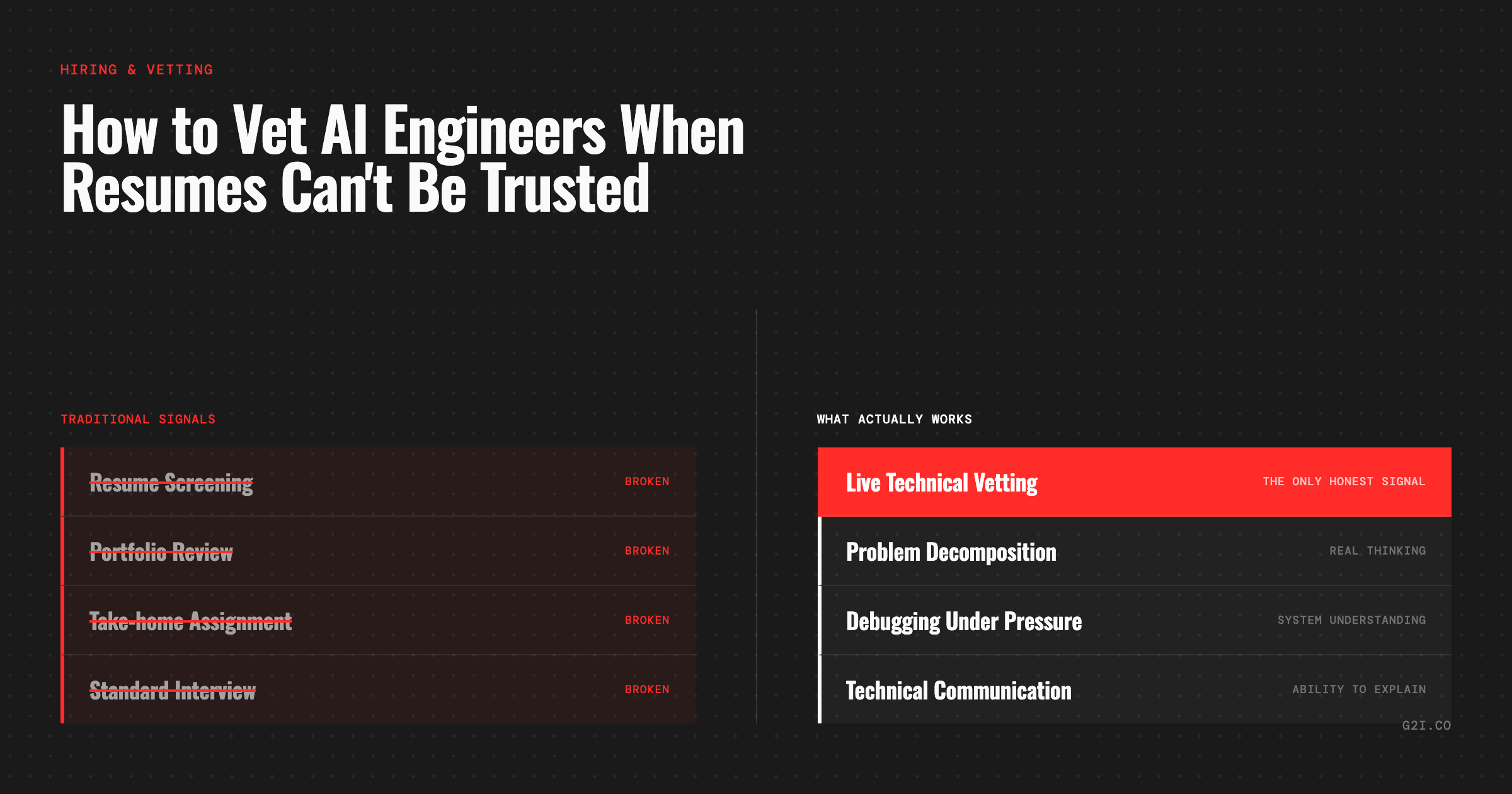
Seventy percent of recruiters have encountered candidates using fabricated credentials, AI-generated work samples, or deepfake video in interviews. Gartner projects that one in four candidate profiles will be entirely fake by 2028.
If you're hiring AI engineers right now, the signals you used to trust are broken.
Resumes are polished by the same models your engineers use to write code. Portfolios are generated in minutes. Take-home assignments get outsourced to Claude or ChatGPT before your team even opens the submission. Interview answers sound rehearsed because they are. Candidates prep with AI coaches that simulate your exact question format.
The traditional hiring funnel was designed for a world where fabricating credentials took effort. That world is gone.
We run a technical talent operation at G2i. We've placed thousands of engineers into AI projects for companies building at the frontier. And we learned this lesson the hard way.
The hire that looked perfect
We hired a senior leader for one of our business lines. His resume checked every box. Interviews went well. References were solid.
When it came time to do the work (build project structure, manage complex datasets, run operations), he couldn't do it. He had no real understanding of the domain. Everything that made him look qualified on paper was surface-level.
That was the moment it clicked: in the AI era, the gap between what someone says they can do and what they can actually do has never been wider. AI tools didn't create dishonest candidates. They gave honest-sounding answers to people who hadn't done the work.
Why traditional screening fails for AI roles
The problem isn't just fake resumes. The problem is that every screening step in a typical hiring process relies on signals that AI can now manufacture cheaply.
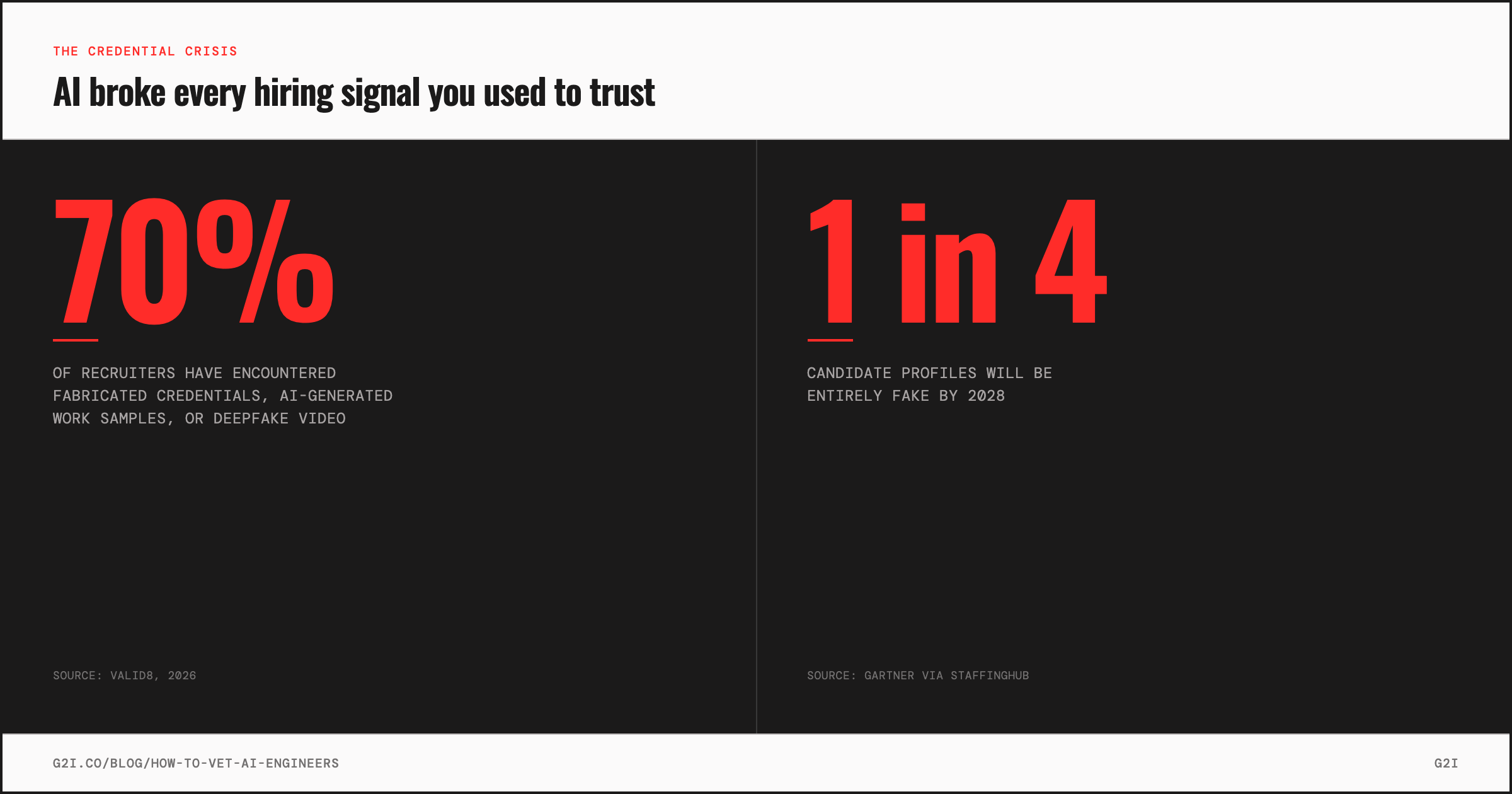
Resume screening: AI tools generate keyword-optimized resumes tailored to any job description in seconds. Candidates submit hundreds of applications with resumes that pass ATS filters perfectly. Recruiters report a 30-50% increase in application volume since 2023, while hire rates stay flat. The signal-to-noise ratio is collapsing.
Portfolio review: GitHub repos, project writeups, and code samples can be generated or heavily augmented by AI. A candidate with a polished portfolio of AI projects may have written very little of the code. The portfolio used to be proof of work. Now it's proof of access to tools.
Take-home assignments: These were already flawed. They self-select for candidates with free time, not necessarily the best engineers. Now they're worse. A take-home returned in 48 hours may have been written by an agent in 20 minutes. You're evaluating AI output, not engineering judgment.
Standard interviews: Behavioral questions and even technical Q&A can be prepped with AI interview coaches. Candidates practice against model-generated versions of your questions. The answers sound right because the model trained on thousands of correct answers. The candidate just has to remember the script.
None of this means every candidate is cheating. Most aren't. But the ones who are have become nearly impossible to distinguish from the ones who aren't. And that's the problem. When you can't tell the difference, you've lost the ability to screen effectively.
What actually works: watching people build
The only hiring signal AI can't fake is watching someone do the work in real time.
Not a whiteboard algorithm puzzle. Not a timed LeetCode sprint. Those test a narrow skill under artificial pressure, and they've always had a high false-negative rate, disqualifying strong engineers who don't perform well in that specific format.
Live technical vetting means putting a candidate into a real work scenario and watching how they think, build, debug, and communicate while they're doing it. The tasks mirror what the job actually requires. The environment allows AI tools, because that's how engineers work now. What you're evaluating is the candidate's judgment, not their memory.
Here's what we look for:
Problem decomposition. Can they take an ambiguous requirement and break it into concrete steps? This is the skill AI can augment but can't replace. The candidate who immediately starts prompting an AI tool without understanding the problem is easy to spot in a live session. The one who asks clarifying questions, sketches an approach, and then uses AI as an accelerator? That's the engineer you want.
Debugging under real conditions. Hand someone a broken system and watch what they do. Do they read error messages carefully? Do they form hypotheses and test them systematically? Or do they paste the error into ChatGPT and hope for the best? Live vetting reveals the difference between someone who understands systems and someone who depends on tools to understand for them.
Technical communication. Can they explain what they're doing and why while they're doing it? This matters more than it used to. AI-augmented teams need engineers who can articulate their reasoning to both humans and AI tools. If someone can't explain their approach to you, they can't prompt effectively either.
Adaptability when the spec changes. Mid-session, shift the requirements. Add a constraint. Remove a dependency. Watch how the candidate adjusts. Rigid engineers who built a mental model and can't update it are a liability on AI projects where requirements change continuously.
How this works at scale
G2i built its business on live technical vetting long before the credential crisis hit. When we started, it was a differentiator for recruiting. Now it's the foundation of everything we do.
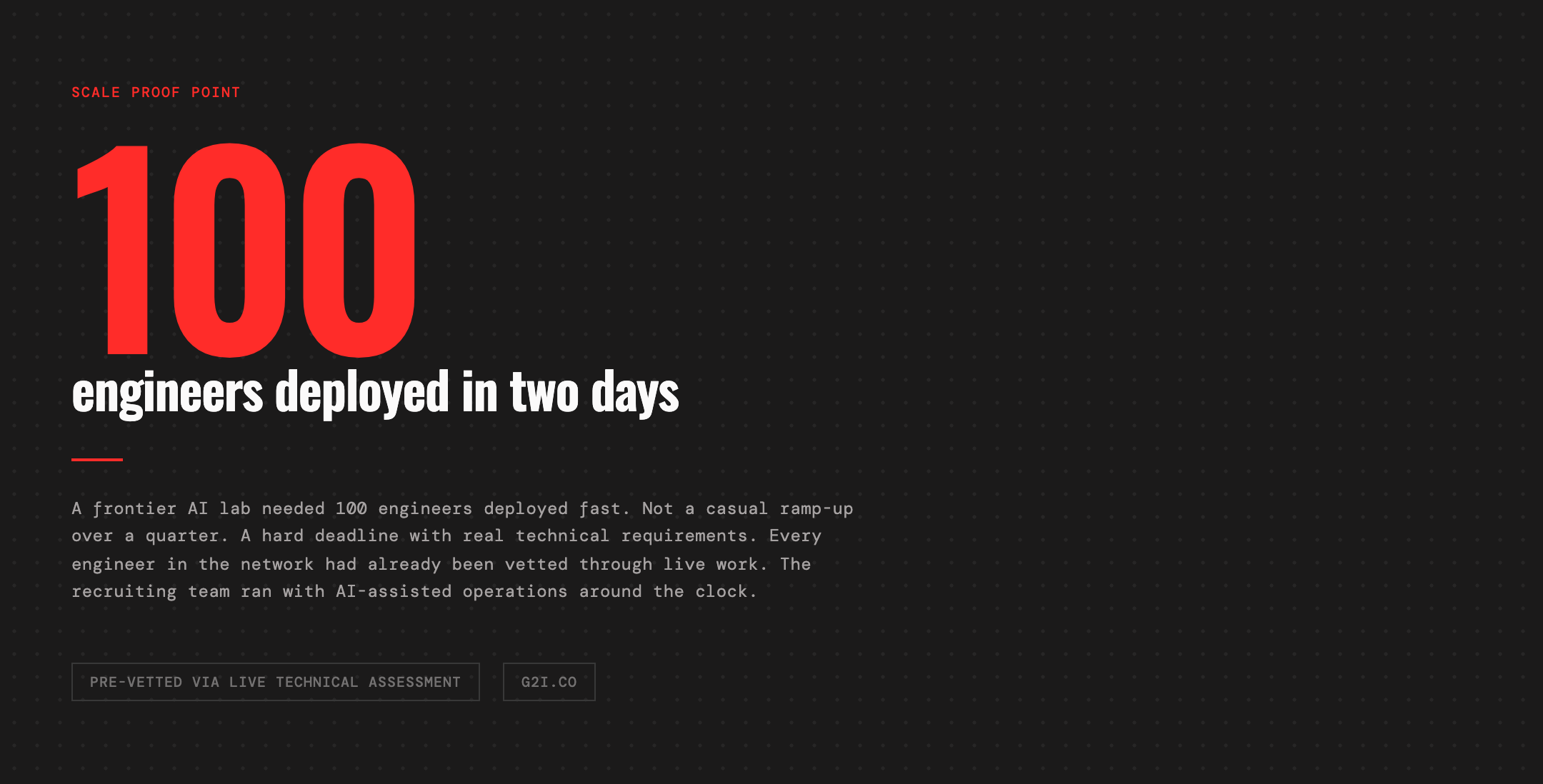
A frontier AI lab needed 100 engineers deployed in two days. Not a casual ramp-up over a quarter. A hard deadline with real technical requirements. We did it. We were able to move that fast because every engineer in our network had already been vetted through live work, not resume review. The recruiting team ran with AI-assisted operations around the clock: finding, testing, onboarding, and deploying at a pace that traditional staffing firms can't match.
That speed isn't possible if your vetting process depends on take-homes that take a week to grade, or panel interviews that need five calendars aligned, or reference checks that return polite non-answers. It's possible because live vetting frontloads the evaluation. By the time a client needs an engineer, the hard part is already done.
A practical vetting framework for AI engineering roles
If you're building a vetting process for AI engineers, here's what we've learned works.
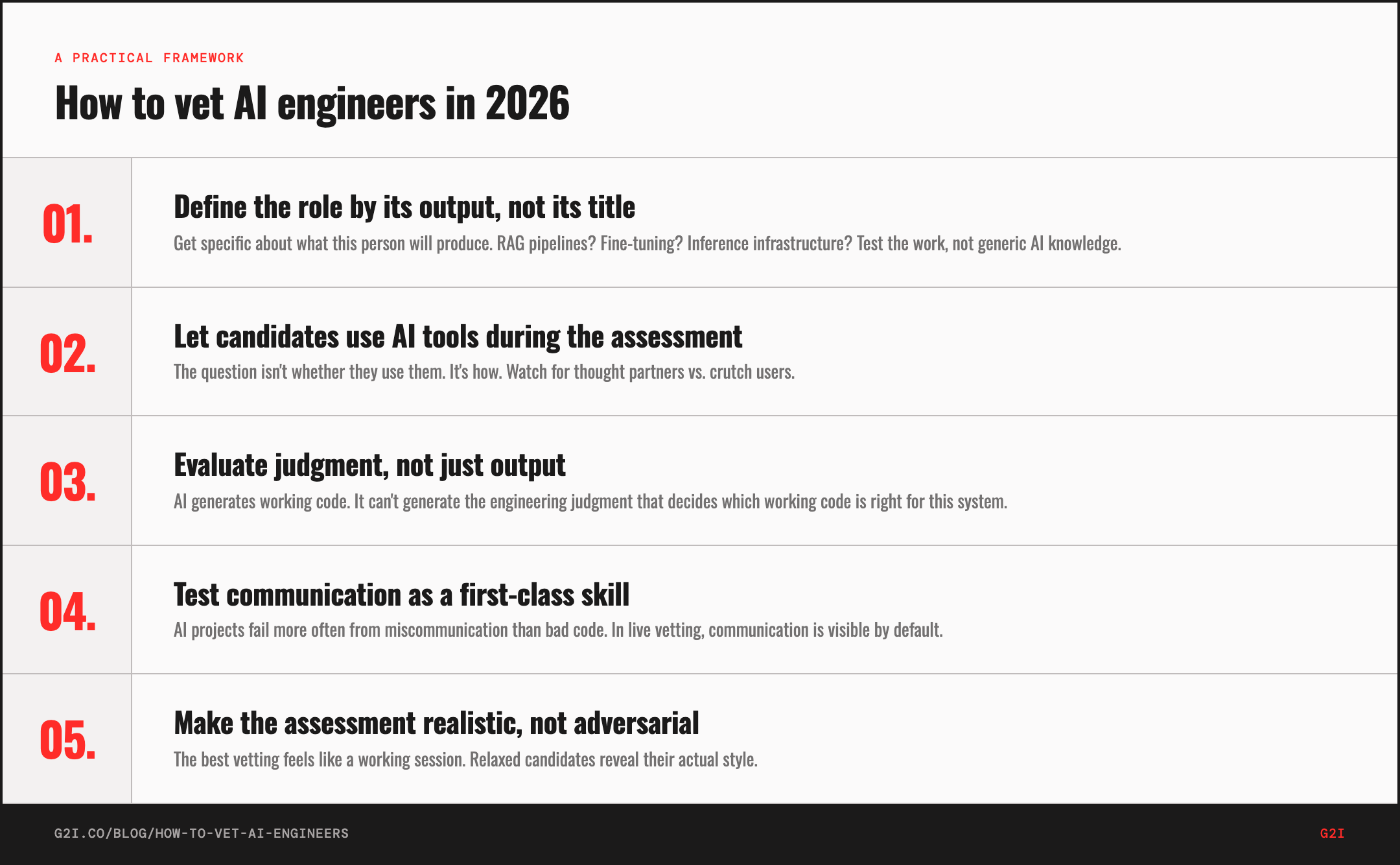
1. Define the role by its output, not its title
"AI Engineer" means something different at every company. Before you screen anyone, get specific about what this person will actually produce. Are they building RAG pipelines? Fine-tuning models? Deploying inference infrastructure? Writing evaluation harnesses?
The vetting should test the specific work, not generic AI knowledge. An engineer who's excellent at building production ML pipelines may fail a coding challenge focused on prompt engineering, and that tells you nothing about whether they can do the job you need.
2. Let candidates use AI tools during the assessment
Banning AI tools from your technical assessment is like banning Google from a coding interview in 2015. It tests something, but not the thing that matters.
The engineers you want to hire are already using AI tools daily. The question isn't whether they use them. It's how. Watch for the difference between someone who uses AI as a thought partner (asking it to check their reasoning, generate test cases, explore alternatives) and someone who uses it as a crutch (pasting the entire problem and submitting the output).
3. Evaluate judgment, not just output
The code a candidate writes matters less than the decisions they make while writing it. Why did they choose that architecture? What tradeoffs did they consider? What would they do differently with more time?
AI can generate working code. It can't generate the engineering judgment that decides which working code is right for this system, this team, this set of constraints. That judgment is what you're hiring for.
4. Test communication as a first-class skill
AI projects fail more often from miscommunication than from bad code. The engineer who can explain a complex system to a non-technical stakeholder, write clear documentation, and articulate their reasoning during a code review is worth more than the one who writes marginally better code in silence.
In a live vetting session, communication is visible by default. In a take-home, it's invisible.
5. Make the assessment realistic, not adversarial
The best vetting doesn't feel like a test. It feels like a working session. When candidates are relaxed and engaged, you see their actual working style, which is what you're trying to evaluate. Pressure-cooker assessments reveal who handles artificial stress well, which is a different skill than building reliable AI systems.
The cost of getting this wrong
A bad AI engineering hire doesn't just waste a salary. They introduce technical debt into systems that are hard to audit, make architectural decisions that compound over months, and slow down the engineers around them who have to review and fix their work.
In AI projects specifically, the damage is worse. A poorly built training pipeline produces bad data. A misconfigured evaluation harness gives you false confidence in model performance. A sloppy deployment creates reliability problems that erode customer trust. These aren't bugs you catch in a sprint review. They're failures that surface weeks or months later.
The hiring market for AI engineers is tight. The pressure to fill roles fast is real. But the fastest path to a productive team isn't lowering the bar. It's changing what you measure. Stop screening for credentials AI can manufacture. Start screening for judgment AI can't fake.
What G2i does differently
G2i's entire model is built on the idea that watching engineers work is more reliable than reading about them. Every engineer in our network goes through live technical vetting designed by experienced engineers. Not resume screening. Not automated coding challenges. Not chatbot interviews.
We test real-world scenarios that match the actual work our clients need. We evaluate judgment, communication, and adaptability alongside technical skill. And because we've already done the vetting, our clients can move fast when they need to staff an AI project without sacrificing quality.
If your hiring process still depends on resumes and take-homes, it was designed for a different era. The companies that figure this out first will build better teams. The ones that don't will keep paying for credentials that don't translate to delivery.
G2i places pre-vetted AI engineers into frontier AI projects. Every developer in our network has been evaluated through live technical assessment, not resume screening. Talk to us about building your AI team.